Summary
Three studies show how the design of the ask itself — independent of any matching offer — shapes results. The single biggest leak in most fundraising appeals turns out to be hassle.
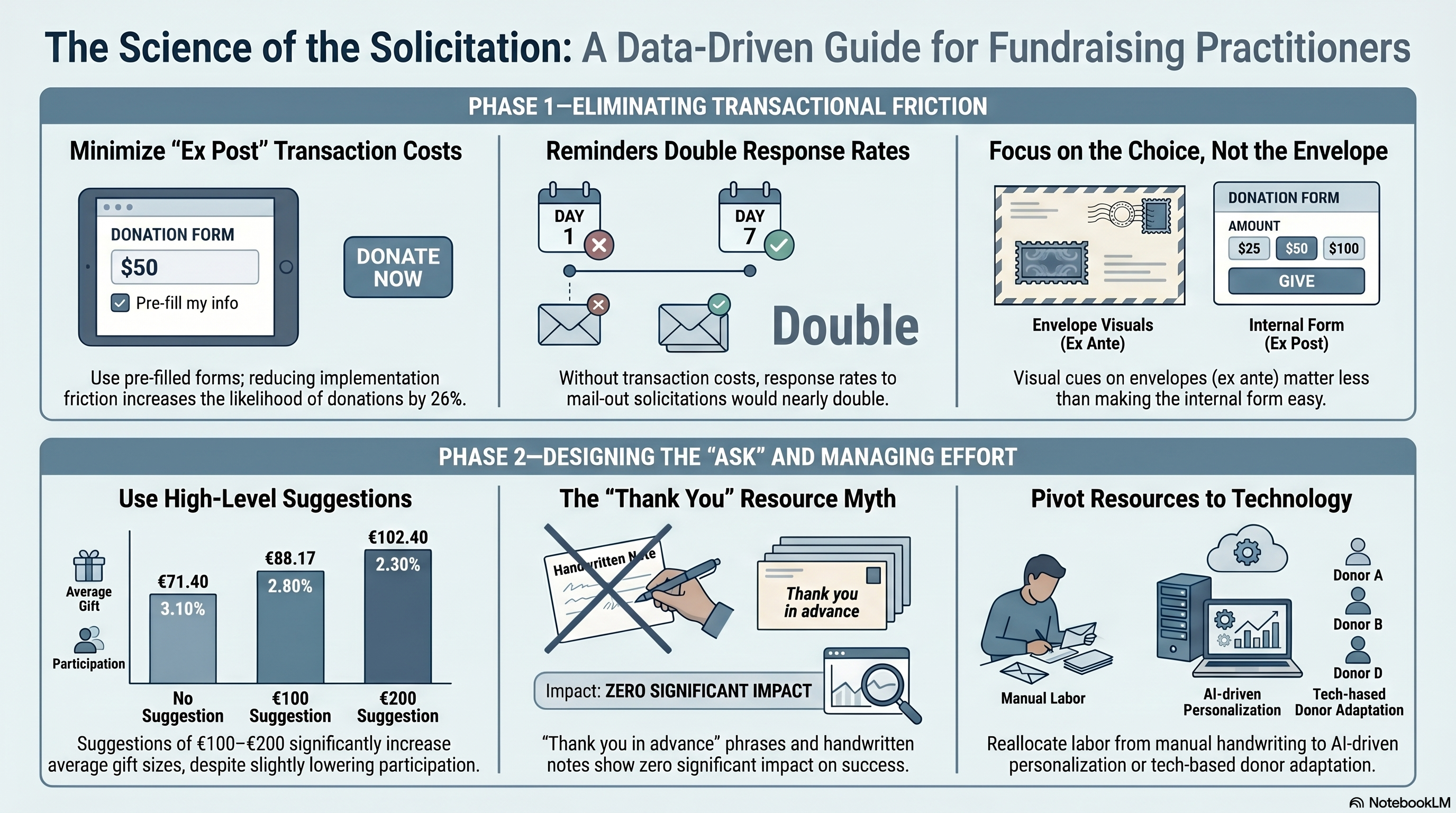
When recipients had to find a bank account number and fill out a transfer form themselves, nearly half of those who would have given simply did not. Pre-filling the form and offering a credit-card option lifted response by 26%. The lesson is blunt: every step of friction costs you donors.
The second study tested suggested donation amounts (EUR 100 or EUR 200) printed on the form. Suggestions raised the average gift but lowered the response rate, with a small net positive — and the effect persisted a year later. Anchors matter, so choose them carefully.
The third tested two intuitions every fundraiser shares: that handwritten thank-you cards and "thank you in advance" phrases boost giving. Two preregistered field experiments found exactly zero effect for either. A polished, frictionless ask with a thoughtful suggested amount beats elaborate gratitude rituals every time.
Explore
Listen
Watch
Infographic
Papers
Huck, S. & Rasul, I. (2010). Transactions costs in charitable giving: Evidence from two field experiments. The B.E. Journal of Economic Analysis & Policy, 10(1).
PDF →Adena, M., Huck, S. & Rasul, I. (2014). Charitable giving and nonbinding contribution-level suggestions: Evidence from a field experiment. Review of Behavioral Economics, 1(3), 275–293.
PDF →Adena, M., Huck, S. & Neyse, L. (2025). Gratitude in fundraising: do ‘thank you in advance’ and handwritten thank you notes impact fundraising success? Experimental Economics, 28(4), 900-909.
PDF →