Summary
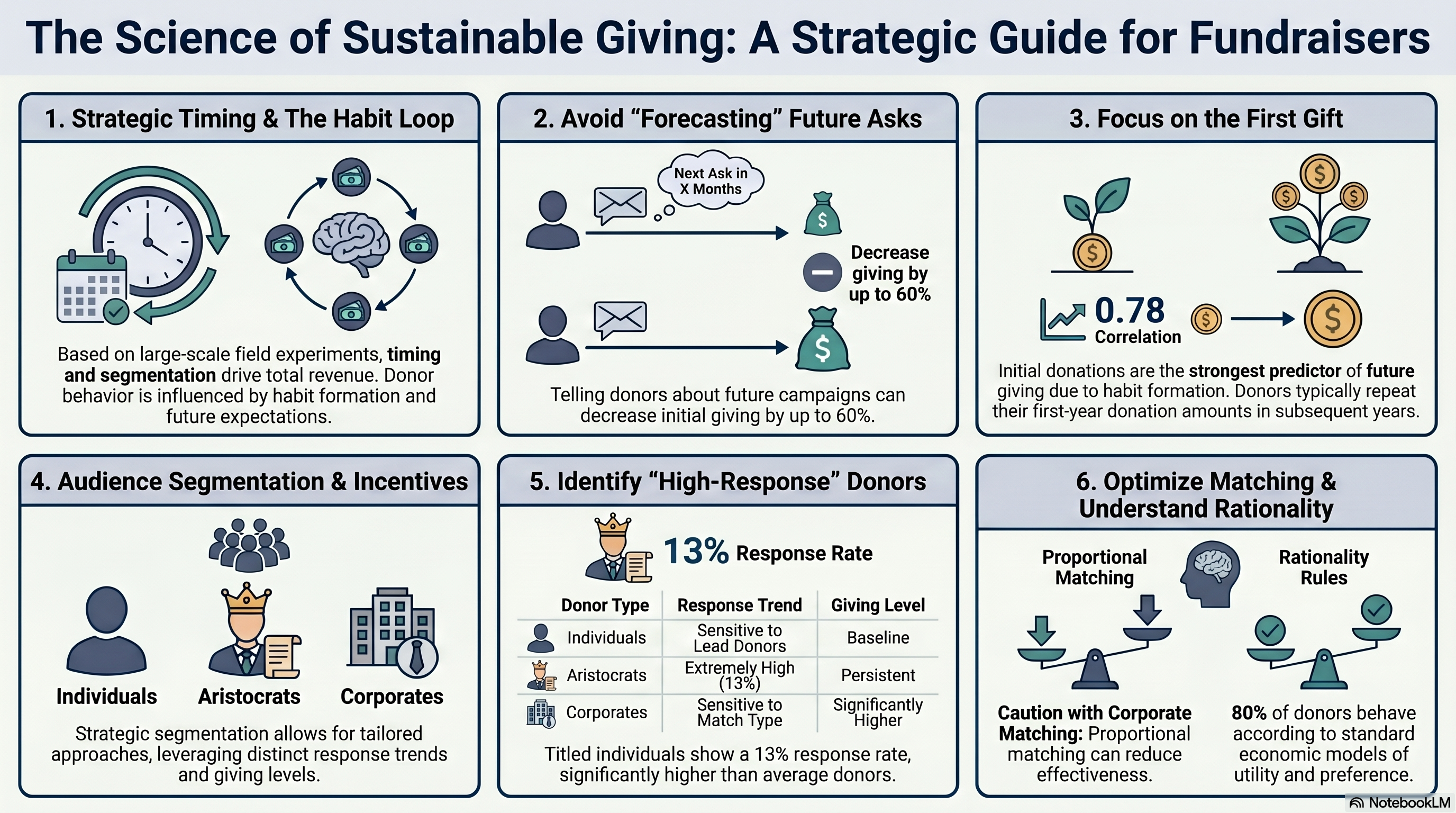
Treating "the donor" as a single type loses information that matters. Within the same Bavarian Opera campaign, aristocrats responded at an extraordinary 13% rate — driven by something close to social obligation.
Corporate donors, by contrast, gave less when matching was offered, suggesting their giving is motivated more by competitive signalling than by warm-hearted altruism. A separate study using the same donors' behaviour across multiple price levels found that more than 80% of recipients chose in a way consistent with the basic axioms of consumer theory — donors are coherent decision-makers, not impulsive.
Most strikingly, what donors do today is the best predictor of what they do tomorrow. In a two-year experiment at Dresden's Semperoper, year-one and year-two giving correlated at 0.78. Telling donors in advance that they would be asked again actually reduced their first-year gift, but the second-year gift held strong regardless.
Practical takeaway: segment your file (corporates, individuals, repeat donors), and recognise that the first gift you secure from a new donor essentially sets the relationship.
Explore
Listen
Watch
Infographic
Papers
Adena, M., Huck, S. & Rasul, I. (2017). Testing consumer theory with unit demand and two goods. Journal of the Economic Science Association, 3(1), 1–16.
PDF →Bassi, A., Huck, S. & Rasul, I. (2017). A note on charitable giving by corporates and aristocrats: Evidence from a field experiment. Journal of Behavioral and Experimental Economics, 66, 104-111.
PDF →Adena, M. & Huck, S. (2019). Giving once, giving twice: A two-period field experiment on intertemporal crowding in charitable giving. Journal of Public Economics, 172, 127–134.
PDF →