Summary
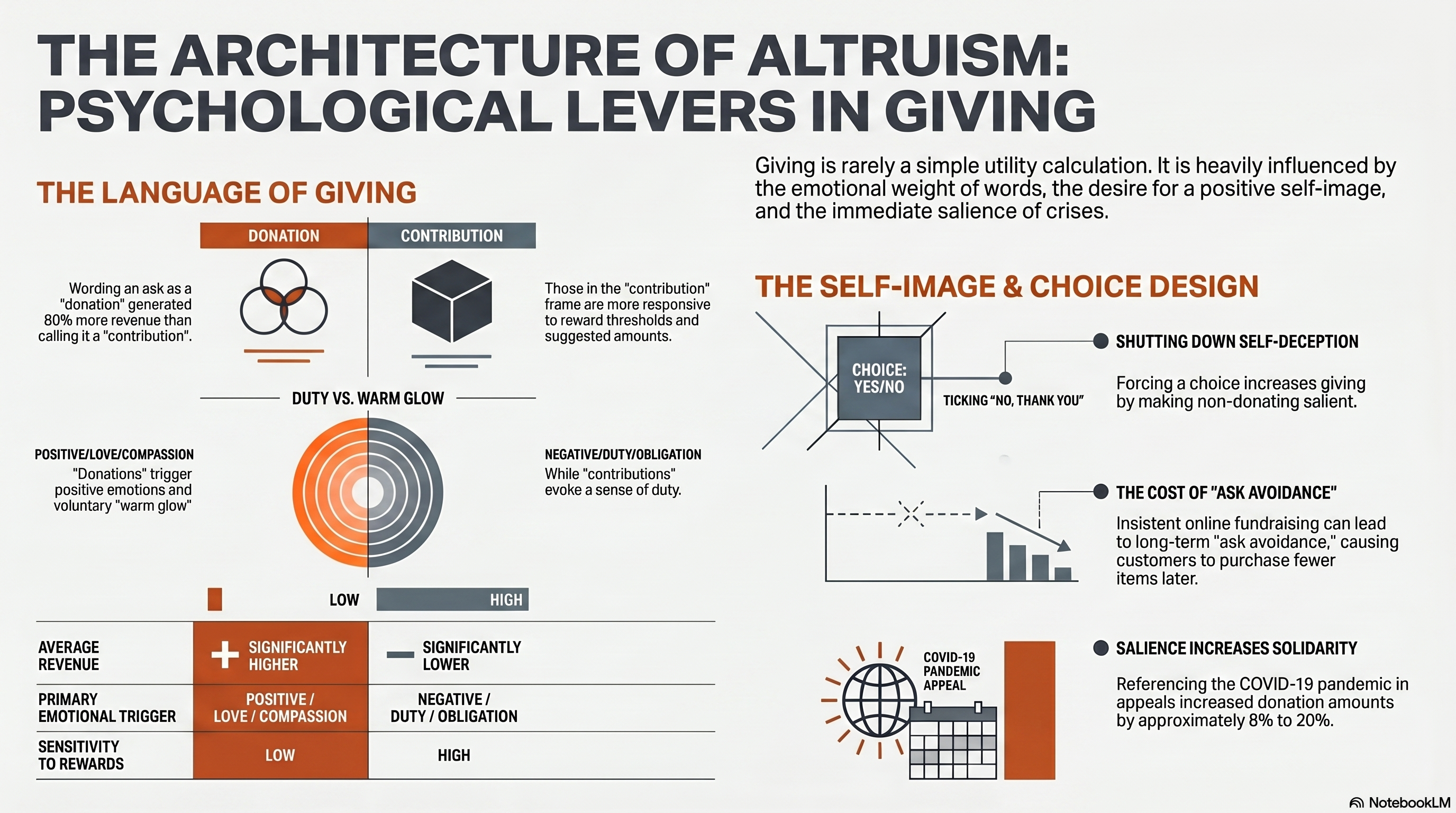
Three studies reveal psychological levers that move giving without touching the price. The first finding is striking in its simplicity: the word you use matters enormously.
A crowdfunding campaign for an institute summer party raised 80% more under the framing "donation" than "contribution" — and a follow-up showed the word "contribution" actively triggered negative emotions in givers.
The second study examined online ticket purchases at the Munich Opera. Forcing customers to actively click either "No, thank you" or "Already donated" — rather than letting them silently bypass — increased giving six- to sevenfold. But there was a hidden cost: those forced-decision customers bought fewer opera tickets the next season, quietly substituting away to avoid the awkwardness.
The third examined giving during COVID-19. Donations rose where the pandemic was more severe locally and where media coverage was heavier — even after stripping out economic hardship effects. Practical takeaways: choose your words carefully, ask for a decision rather than letting people slip past silently (but watch for backlash), and ride moments when your cause is in the news.
Explore
Listen
Watch
Infographic
Papers
Adena, M. & Huck, S. (2022). Donations and contributions: The info effect. Experimental Economics, 25, 1424–1442.
PDF →Adena, M. & Huck, S. (2020). Online fundraising, self-image, and the long-run. Management Science, 66(10), 4795–4812.
PDF →Adena, M. & Harke, J. (2022). COVID-19 and pro-social behavior. Experimental Economics, 25, 1944–1962.
PDF →