Summary
Three studies look beyond the individual letter or campaign to the broader environment that shapes giving — online platforms, quality signals, and the tax system itself.
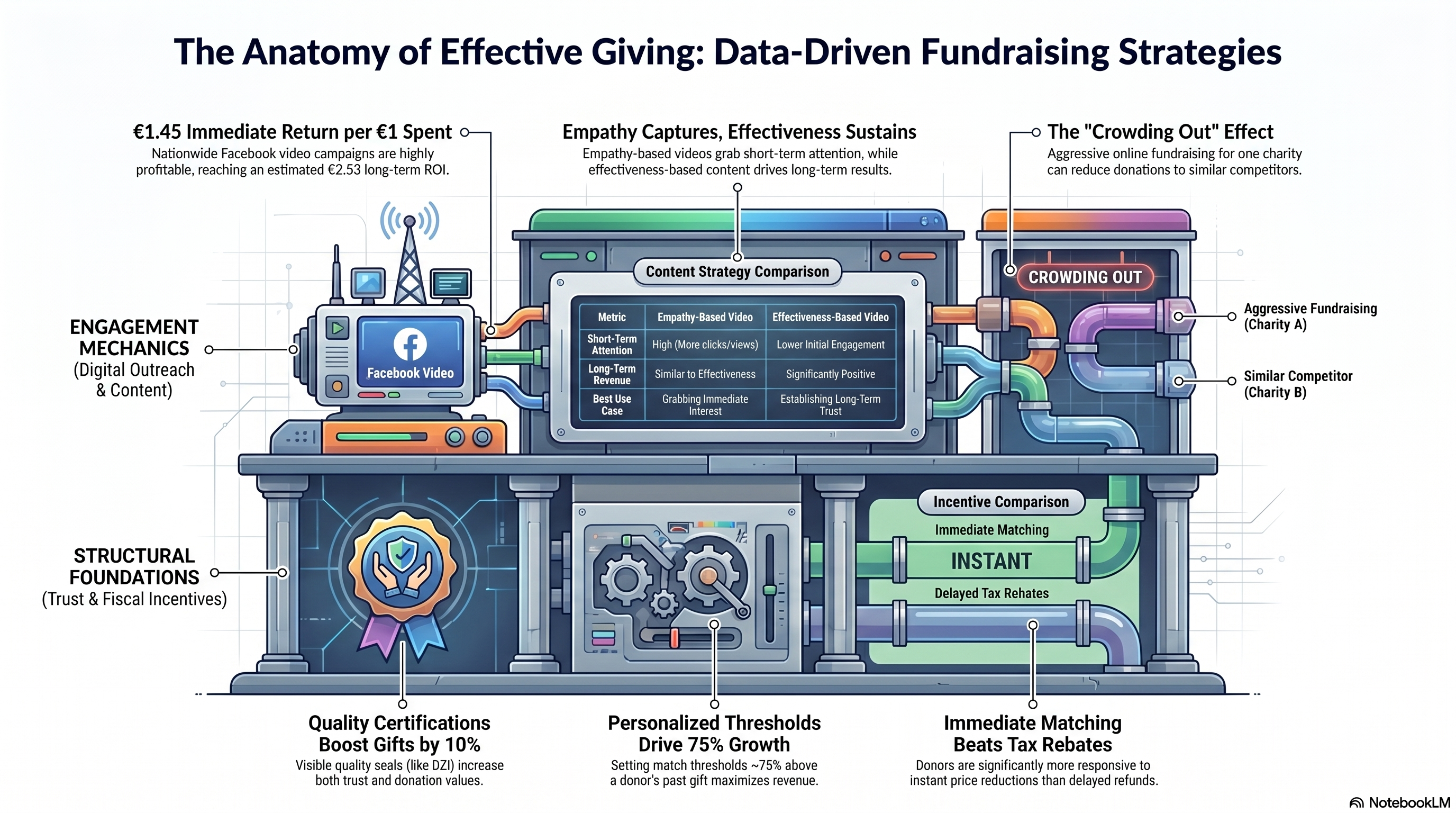
The first ran a Facebook video fundraising campaign across 94% of Germany's postcodes for Save the Children. Online fundraising clearly works: every EUR 1 spent returned about EUR 1.45 immediately and an estimated EUR 2.53 long-term. But the campaign also drained giving to other children's charities — competition for donor attention is real and underappreciated.
The second tested whether a respected quality certificate (Germany's DZI seal) raises donations. It does — by about 10% — and the cost of obtaining the seal is modest. But the boost mostly comes from new donors who are forming a first impression of the organisation. Existing donors, who have already made up their minds, barely respond.
The third reviews what field experiments tell us about tax incentives for giving. The standard tax-deduction model, where donors wait months to claim a refund, consistently underperforms simpler alternatives like an instant match via the charity's tax number or a flat 15% subsidy on every gift. Policy design matters — and the current system is probably the wrong tool.
Explore
Listen
Watch
Infographic
Papers
Adena, M. & Hager, A. (2024). Does online fundraising increase charitable giving? A nationwide field experiment with Facebook. Management Science, 71(4), 2751-3636.
PDF →Adena, M., Alizade, J., Bohner, F., Harke, J. & Mesters, F. (2018). Quality certifications for nonprofits, charitable giving, and donor information. Journal of Economic Behavior and Organization, 159, 75-100.
PDF →Adena, M. (2021). How can we improve tax incentives for charitable giving? Lessons from field experiments in fundraising. In: The Routledge Handbook of Taxation and Philanthropy, 344-335.
PDF →